Monday, January 10, 2011

How Much Ambulance Ride Cost

Babies, language and film

Well finally came to an end the holiday and it's time to get to work with great enthusiasm. For me one of the nicest aspects of the holiday is to catch up - or at least try to catch up "in local movie listings. Now on holiday came third in the trilogy of films that began with "my girlfriend's family" with Robert de Niro and Ben Stiller. To enjoy it fully, so I decided to rent the DVD of the second part, "The My husband's family. " A fun aspect of this movie is the plot in which Jack Byrnes (Robert De Niro) seeks to educate her grandchild as if it were a adultito, and forbids anyone you talk to the tone or the honeyed words that we often hear or do when we go to small infants.


Well, all this is irrelevant because just in this year's first issue of the journal Cerebral Cortex, Katherine Travis, and his colleagues at the University of Califonia at San Diego published an article suggesting that infants between 12 and 18 months of age and processed language as it does adults.

In reaching this conclusion, the authors used the technique of magnetoencephalography in combination with structural magnetic resonance imaging. This allowed them to estimate the spatio-temporal brain activity selective for words in children between 12 and 18 months of age. The task was to bring them to see pictures of common objects and to hear words that they understood. A subset of these infants also heard familiar words compared with sounds. In both experiments, the words evoked the typical event-related brain responses that occur when listening to words, and displayed to 400 milliseconds after word began. In adults this activity called N400 is associated with lexical-semantic encoding and is located in the left hemisphere frontotemporal cortices. As in adults, the authors found that the amplitude of the N400 is also modulated by prior exposure semantics, known as priming, and is reduced by words that are preceded by a semantically related picture. These findings suggest that both children and adults use the frontotemporal areas left You to encode lexical-semantic information.


This suggests that after all there is some truth to the claims of Robert de Niro in the role of Jack Byrnes in saying that her grandson in the movie means more than it seems, however, as mentioned in other blogs , loving approach to infants brings emotional information that goes beyond simple semantic meaning of words, so we do not have to feel bad when we stammer borucas front of a boy or girl who actually seems to enjoy our foolishness.

Thursday, January 6, 2011

Is Scorpio Man Interested?

Happiness.

happened that was the seller in the sale,
and this child was eight years asking the price of the laser gun and to find away for a moment, and return the salesman asked, "what came across, and the boy told ... Lord, how it is to convince a grandmother ...?. the seller he said. "Put a kiss on her cheek, and talk of incommensurable love." The child gave the nuevamente.Regresó thanks and walked away, and the salesman asked, "How are we doing" and the boy said, "It is proving much." Then the salesman said, "It's time to burn bridges." "Tell him that his indifference is causing pain in his chest." reaching the child not to give way to the second point, neither the seller to complete their education, when it appeared her: "What is all this," he said. "First, the incommensurable love of his grandchild," said the seller.
_ "If even kissed me," said Buela.
_ "There you are," said elvendedor.
_ "I knew this was going to be pure expenditure," he complained.
seller Before delving into his arsenal, the boy took from his little life and great intelligence this cluster bomb, "Grandma does not matter if I buy it or not ... I love you just as you said" .
_ "Ya, ya, ya," said the grandmother, "but not that of 2500." ****

Thursday, December 30, 2010

What Is The Best Pre-workout From Mp

The brothers spread throughout the world.

Tarsis Brothers, Nineveh, Corinth, Rome, Sodom, Transylvania.
And many remembered places.
wish for you, all my desire, so far limited the meat.
Happy New Year, and energy to keep this coming.
I let the words of the greatest:
"Be harmless as doves and wise as serpents."
A hug. ****


And many remembered places

Friday, December 24, 2010

Kates Playground Legs

"CHILDREN AND ADULTS USING THE SAME PAY ATTENTION TO BRAIN REGIONS?

Well, we reached the end of year celebrations and I think today is a good day to raise the Blog this week. This time I'll upload an entry written by Martha Beatriz Moreno-related brain differences between children and adults to pay attention.


"CHILDREN AND ADULTS USING THE SAME PAY ATTENTION TO BRAIN REGIONS?

Apparently yes, but with different intensity and specificity. Childhood and adult brain is different in form and function in some aspects. For example, children have more gray matter (neuron bodies) and less white matter (neuronal axons) than adults. As we grow the white matter increases as the axons of myelinated neurons, ie, fat covering that allows for better conduction of nerve signals. But he also noted that to solve the childhood and adult brain functions differently. To explore such differences Konrad and colleagues (2005) conducted an MRI study which involved 32 subjects (16 adults from 20 to 34 years and 16 children from 8 to 12 years). Each participant had to attend to visual stimuli presented on a screen inside the scanner magnet. In children and adults presented the same set of images composed of different visual stimuli: fixing (a cross), warning (asterisk) and target images (5 arrows) presented as a column. Each participant had to be vigilant in identifying when the image appeared of 5 arrows. Main focus should be put in the direction of the arrow in the middle to press the left button of a keypad near your hand when that arrow pointing to the left or the right button when pointing to the right. (See Figure 1)

Figure 1. Visual stimuli presented to subjects (in Konrad et al., 2005:431)


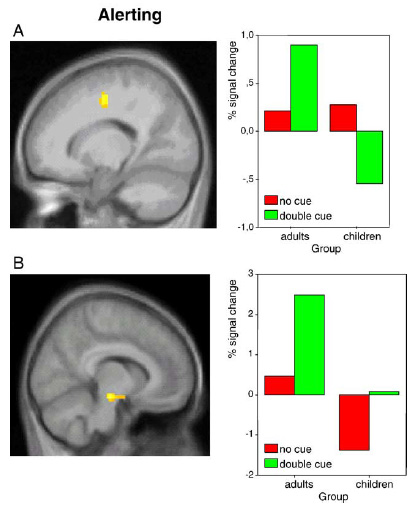
The results showed that all participants selected the same region, but children and adults had different patterns of activación. Al estar alerta, se activó principalmente una región de la corteza frontal llamado giro del cíngulo frontal derecho (figura 2A) y una estructura subcortical denominada tallo cerebral (figura 2B), el cual es la continuación de las fibras que conforman la médula espinal. Las discrepancias en el tamaño de las barras corresponden a diferencias en la intensidad de señal provocada por los diferentes cambios metabólicos (oxigenación) neuronales de niños y adultos al resolver la tarea. Las barras rojas corresponden a la activación neuronal al estar alertas a las imágenes sin pista y las barras verdes a las imágenes de alerta con pista (doble asterisco). Los autores sugieren que las observed differences are due to different processing mechanisms in children and adults.

Figure 2. Brain activation to the task of alerting images with or without tracks (asterisk).


Seeing the stimulus and to identify if all the column arrows point to the same direction (congruent) or not (mismatch), adults had greater activation in superior parietal cortex and the inferior frontal gyrus than boys (Figure 3A and B) and greater activation in the superior temporal gyrus and superior frontal gyrus in children than in adults (Figure 3C and D). The authors believe that these results give evidence of immaturity of neural networks (parietofrontales) on cognitive tasks. Conclude that the results provide evidence that the attentional system is functional but immature children compared to adults, children showed a more diffuse activation pattern that covers more areas of brain regions than adults. This nature reflects immaturity of the system during childhood, which gets more focus and specialize in the development and experience.


Figure 3. Differences in brain activation between children and adults to address visual stimuli

Research Konrad and colleagues is respectable given the complexity of doing fMRI with children because of the difficulty of having the cooperation, following instructions and stillness that the child should have during the study of resonance magnetic and the importance of their results as they provide evidence of differences in cognitive processing reflected in neural activation differences. This work allows a better understanding of brain functioning children with cognitive tasks. The authors say their figures represent not only a characteristic neural functioning of children, but also the use of different strategies but functional as they enable the child to interact with their environment and their cognitive development continue to develop more efficient cognitive strategies without requiring major neural substrate (Konrad et al, 2005).


REFERENCES Baars and Gage 2007
Cognition, Brain and Consciousness, Academic Press,

Konrad, K., Neufang, S., Thiel, CM et al . (2005). Development of attentional networks an fMRI study with Children and adults. Neuroima433ge, 28 (2), 429-439